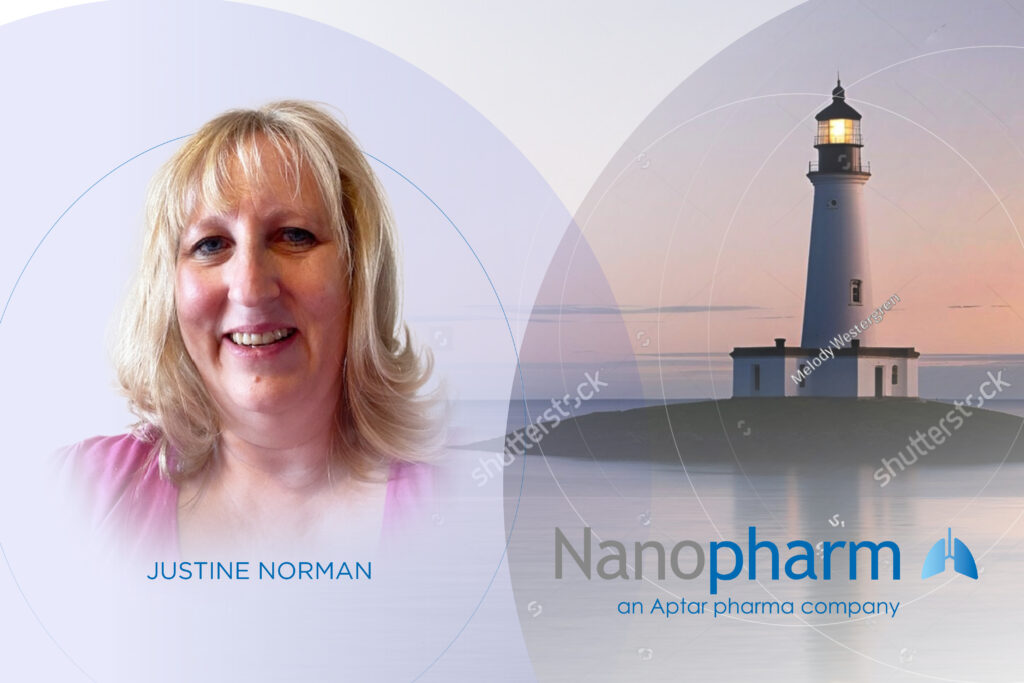
From blue light to light house: How QA should be seen as a force for improvement rather than the police force
“Quality, if done right, should be an enabler, not a barrier.” “We’re here to guide people away from the rocks, not see them crash and then tell them they should have looked where they were going.”
When people think about Quality Assurance (QA), they often picture the ‘quality police’; the team that slows everything down and then turns up again at the end to point out everything that is wrong. For Justine Norman, Manager, Quality, at Nanopharm, that stereotype could not be further from the truth.
For Nanopharm, an organization that sits right at the fulcrum of cutting-edge R&D and rigorous cGMP testing, quality assurance is critical in supporting customers as they look to accelerate and de‑risk the development of their orally inhaled and nasal drug products (OINDPs) from early concept through to market.
A career built on ‘making things right’
Justine’s route into QA started not with a love of checklists, but with a fascination for how complex manufacturing really works. Following her graduation with a degree in microbiology, she began her career at Lonza in large‑scale biologics manufacturing. From the outset she could see how quality impacted on both the practical realities of the shop floor as well as the expectations of regulators.
That dual perspective made a move into QA a natural next step. Since then, she has held senior quality roles across CDMOs where quality drives every operation from batch control and schedule adherence through to customer care; sharpening her commercial instincts as much as her compliance mindset.
Seeing quality as a strategic enabler, not a tactical afterthought
Nanopharm offers a spectrum of services from exploratory R&D through to cGMP release and stability testing for OINDPs. That means QA cannot be a single, rigid set of rules. For example, a risk that is acceptable in early-stage R&D may well be completely unacceptable in a GMP environment. For Justine, that is where pragmatic, risk-based QA is imperative.
Continuous improvement is a key component of this mindset. Wary of ‘onion layers’ of bureaucracy for bureaucracy’s sake, Justine advocates going back to first principles, establishing why the process isn’t working and simplifying or improving it so people can focus on creating value rather than completing forms. In those terms, QA becomes involved at the beginning of projects, shaping processes and highlighting risks, rather than simply signing off documents at the end.
Giving scientists more time to do science
One common tension in R&D organizations is the perception that quality systems and documentation get in the way of innovation. Justine’s view is that good QA does quite the opposite: it gives scientists more time to do science. “We need to talk about the protection of scientific integrity, providing the means by which robust data can be captured consistently and contemporaneously. Quality can be that tool that in the end protects their work and accelerates programs.”
Growing with Nanopharm: from GMP foundations to the next level
Nanopharm’s GMP journey began several years ago, with early QA efforts focused on establishing the rules by helping colleagues understand what GMP is, why it matters, and then putting in place tightly defined systems. Since then, the world has moved on. The team is more experienced and expectations from customers and regulators have grown. In fact, we are delighted to say that we have recently successfully held our first MHRA inspection.
Systems need to evolve to demonstrate greater levels of robustness and efficiency and Justine’s focus is on taking Nanopharm’s quality systems to that ‘next level’ by shifting QA from reactive problem solving to proactive risk management.
She and the wider team are also streamlining end‑to‑end processes, so quality is effectively built into project planning, rather being a bolt on, and encouraging shared ownership of quality across functions, so the people closest to the work identify risks and improvements for themselves.
Why Nanopharm?
Quite simply it was the combination of people, purpose and opportunity. “Gemma spoke with such passion about what Nanopharm is trying to achieve, it was infectious,”
Unlike in larger, more established businesses where change can be slow to implement and practices can be prescriptive, Nanopharm offers Justine the chance to shape systems, culture and processes at a pivotal moment in the company’s growth.
There is a personal connection too. Sadly, Justine has first-hand family experience of the impact COPD and asthma can have and so working on inhalers and nasal products is far from abstract in her mind, the role is as emotionally meaningful as it is technically interesting. “We’re on the cusp of really changing how these products are delivered and being part of that, while helping build a modern, tech‑enabled QA function, felt like Nanopharm was the right place to be.”
The Future of QA: AI, data and lighthouse leadership
Looking ahead, Justine is clear that QA tomorrow will not look like QA yesterday. She has a strong interest in how AI and digital tools can transform quality, from smarter documentation reviews to trend analysis across deviations and complaints.
Her priorities therefore are using technology to automate low value, manual tasks so QA can focus on delivering insight and enabling better decision‑making. Embedding quality thinking is another imperative, providing guidance into the way projects are scoped, resourced and executed, especially as Nanopharm expands its cGMP and clinical trial support capabilities for OINDPs.
“In the end, quality isn’t about saying ‘no’,” “It’s about making sure that when we do say ‘no’, it’s because really matters, and the rest of the time, we’re helping the business do the right thing, first time.” “Our mission is clear: To evolve QA’s identity from ‘blue light’ to ‘light house’ so that we are visibly and actively helping teams navigate complexity.”
To connect with Justine, click here: https://www.linkedin.com/in/justine-norman-22945420/